
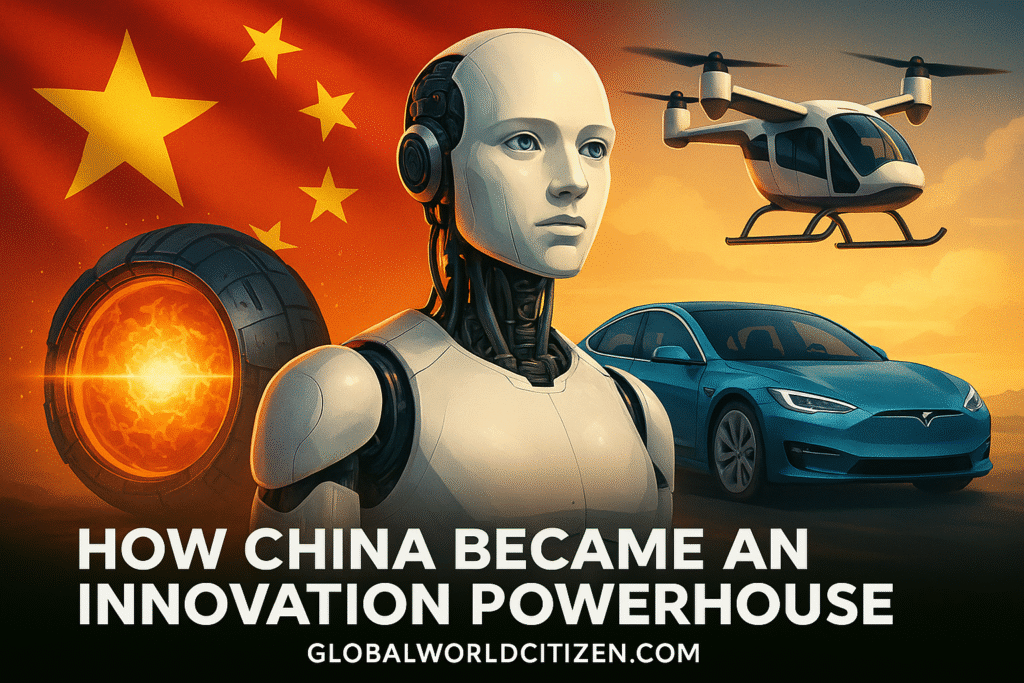
BEIJING / HEFEI / SHANGHAI – Over the last decade, China has transformed into a global innovation powerhouse, leveraging its state-driven research system, vast subsidies, and strategic industrial policies to dominate in fields ranging from electric vehicles (EVs) and lithium batteries to fusion energy, humanoid robots, and quantum technology.
While the results are undeniable — China is now home to world-class startups, leading-edge research hubs, and a thriving tech ecosystem — critics warn that its state-led innovation conveyor belt could be unsustainable, weighed down by overcapacity, debt, and collapsing private investment.
 From Nuclear Labs to Metro Stations: Fusion Energy Innovation
In Hefei, Fusion Energy Tech — a startup carved out from a nuclear research lab — announced plans to commercialize plasma fusion technology hotter than the sun.
Already, it has produced security-screening devices now installed in local metro stations.
Other Hefei innovations include plasma-based cancer treatments in trials and quantum-secure mobile services already on the market.
This is an example of China’s “innovation chain” — taking state-funded lab research and fast-tracking commercialization through government-backed industrial zones.
 China’s EV, AI, and Robotics Revolution
China is already the world leader in EVs and lithium-ion batteries. Now, it is racing ahead in:
Humanoid robots: Dozens of companies are competing to build advanced prototypes.
Flying taxis: Leveraging expertise in EVs and drones, Chinese startups are pioneering this futuristic market.
AI & computer-vision sensors: Firms like Theseus went from teahouse discussions in 2019 to national leaders by 2024, producing next-gen AMOLED displays with China Mobile.
Companies like Xiaomi have also transitioned from smartphones to EV production in just three years, showcasing the flexibility and breadth of China’s innovation model.
 State-Backed Innovation Chains
China’s innovation conveyor belt works like this:
Grants fund researchers in labs and universities.
Government officials identify promising ideas and support commercialization.
Industrial zones provide funding, infrastructure, and supply chain support.
Startups emerge, often with direct backing from local governments.
Between 2019 and 2023, revenue from tech transfer, consulting, and joint development at Chinese universities and institutes nearly doubled to 205 billion yuan ($29B).
Hefei is the flagship model — a city where government, research institutes, and private industry collaborate seamlessly to overcome technological bottlenecks such as quantum devices once only available abroad.
 The Costs of State-Led Innovation
For all its successes, China’s state-led innovation model comes with mounting costs:
Subsidies: Up to 2% of GDP goes toward subsidizing industries.
Private investment collapse: Venture capital dropped 41% YoY in H1 2025, according to KPMG.
Overcapacity: Most of China’s EV makers are unprofitable, with too many firms chasing too few customers.
Involution: Excessive competition erodes value, leaving little room for genuine winners.
Debt burden: Public debt (including local government vehicles) hit 124% of GDP in 2024, raising sustainability concerns.
Experts warn that some industries — from humanoid robots to biotech — are seeing duplication without demand, where dozens of firms chase trends without clear market opportunities.
 National Strategy and Global Impact
China’s central government is scaling up successful models like Hefei nationwide:
1 trillion yuan ($138B) national technology fund launched in 2023 under Zheng Shanjie.
MIIT oversight expanded to accelerate commercialization of industrial research.
New leaders like Li Lecheng are tasked with transforming inland cities into green energy and AI hubs.
This strategy aims to challenge Western dominance in frontier fields while reducing reliance on foreign suppliers.
 GlobalWorldCitizen.com Insight
China’s rise as an innovation powerhouse is reshaping the global economy, technology competition, and geopolitics:
Strengths: Fast commercialization, government coordination, global leadership in EVs, quantum, fusion, and AI.
Risks: Debt, overcapacity, resource misallocation, and declining private innovation.
Global impact: Nations from the U.S. to Europe are responding with tech nationalism, tariffs, and investment screening.
China’s conveyor belt of innovation has created world-class breakthroughs, but its future sustainability is in question. Will China continue to lead the global tech race, or will overextension and inefficiency slow its rise?