
Published: January 29, 2026 Author: Global World Citizen Editorial Team Source: GlobalWorldCitizen.com Category: Global Business · Family Wealth · Consumer Brands · Food & Beverage
From a Small Alabama Counter to a Billion-Dollar Beverage Empire
What began as a simple glass of sweet tea served at a modest burger counter in Birmingham, Alabama, has grown into one of America’s most powerful family-owned beverage success stories.
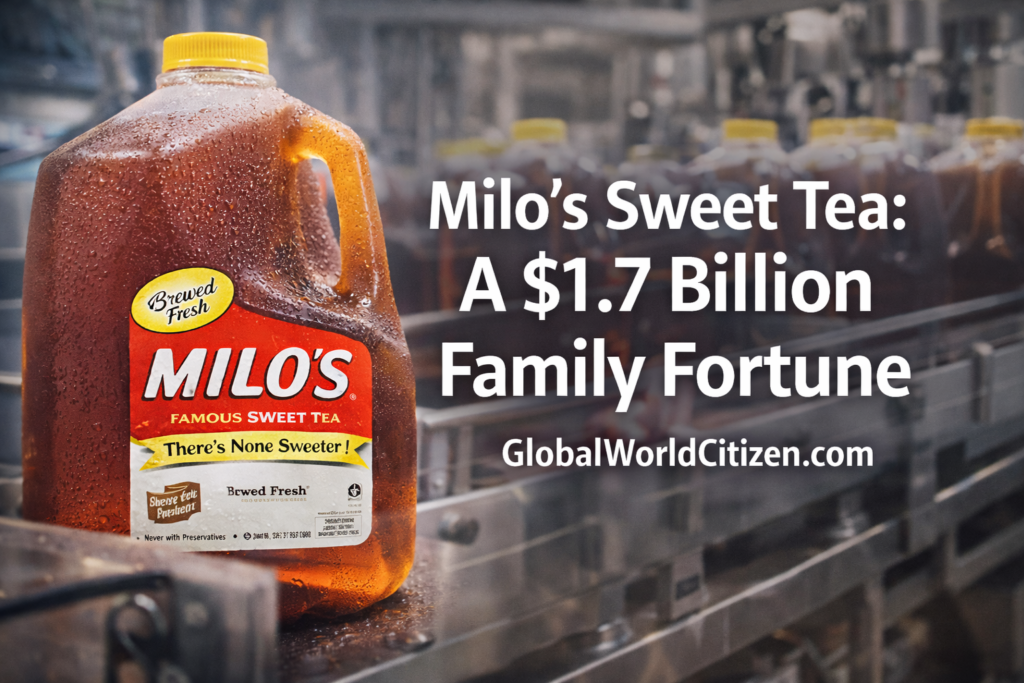
Today, Milo’s Tea Company stands as the top-selling refrigerated iced tea brand in the United States, generating hundreds of millions in annual revenue and underpinning a family fortune estimated at $1.7 billion.
At the center of this transformation is Tricia Wallwork, the third-generation CEO who took a regional Southern staple and scaled it into a national powerhouse—without selling out, cutting corners, or sacrificing family ownership.
A Third-Generation CEO With a Long-Term Vision
When Wallwork assumed leadership 13 years ago, Milo’s was a small operation with 40 employees, one production facility in Alabama, and limited national reach. Production ran intermittently, and the brand had yet to unlock its true potential.
Fast forward to today:
-
Over 1,000 employees
-
Three major manufacturing plants (Alabama, Oklahoma, South Carolina)
-
24/7 production cycles
-
Distribution in 60,000+ retail locations, including 4,200 Walmart stores nationwide
-
Annual production exceeding 200 million gallons, or nearly 2 billion servings
“Our growth curve is real,” Wallwork says. “I know because I lived it.”
Betting on Real Sugar in a Sugar-Averse Era
At a time when many consumers have turned toward artificial sweeteners or sugar-free alternatives, Milo’s doubled down on authenticity.
Each serving of Milo’s signature sweet tea contains 26 grams of real cane sugar—no preservatives, non-GMO ingredients, and brewed from real tea leaves, not concentrates or powders.
Despite shifting dietary trends, demand continues to surge.
Industry analysts note that Milo’s success proves one thing clearly: consumer loyalty still favors authenticity over trends.
Dominating the Refrigerated Tea Market
According to Nielsen IQ, Milo’s became the No. 1 selling refrigerated tea brand in America in 2025, with its iconic gallon jug ranking as the top-selling ready-to-drink tea product across U.S. retailers.
Even compared to shelf-stable giants like Arizona Iced Tea, Milo’s now leads in total dollar sales, not just unit volume.
And it’s not just tea.
-
Milo’s Lemonade is currently the fastest-growing lemonade brand in the U.S.
-
The company produces nine core flavors, three size formats, and is expanding to 11 flavors, including seasonal releases and zero-sugar lines
Profitable, Scalable, and Still 100% Family-Owned
Despite heavy investment in manufacturing and logistics, profitability remains strong.
-
Estimated EBITDA margins: ~20%
-
Projected 2025 retail sales: $1 billion
-
Estimated annual revenue: $750 million
-
Conservative valuation estimate: $1.7 billion
The Carlton family—Wallwork, her father Ronnie, stepmother Sheila, and sister Leslie—still own 100% of the company and have no plans to sell.
“We believe the hardest challenges are solved over generations, not quarters,” Wallwork explains.
Purpose-Driven Growth in a Scale-Obsessed World
Beyond revenue, Milo’s has embedded purpose into its operating model:
-
Zero-waste certified
-
1% of profits donated to education and environmental charities
-
Heavy reinvestment into U.S. manufacturing and jobs
In 2025, the company opened a $200 million manufacturing and distribution facility in South Carolina, drawing 23,000 job applicants for just 129 roles—a testament to brand reputation and leadership culture.
From WWII Roots to Modern Retail Dominance
Milo’s origin story dates back to 1946, when Milo Carlton returned from World War II, married his wife Bea, and opened a small restaurant in North Birmingham.
Sweet tea quickly became the standout product.
By the 1980s, the family began franchising the restaurant concept and delivering tea to locations across Alabama. In 1989, recognizing strong consumer demand, they began selling sweet tea in gallon jugs at local grocery stores—a move designed to signal freshness and the absence of preservatives.
That same year, Milo’s landed its first Walmart supercenter account in Jasper, Alabama.
In 2002, the family sold the restaurant business—but kept the tea, a decision that would prove transformational.
A Reluctant Heir Who Became a Transformational Leader
Despite growing up inside the business, Wallwork initially resisted joining it. After earning degrees in philosophy, Spanish, and law, she worked as an attorney before becoming disillusioned with corporate legal life.
At 29, she joined Milo’s as general counsel. The company then had just 16 employees, two flavors, and manual jug-filling lines.
By 2012, Wallwork was named CEO.
Her early strategy was simple: distribution first.
“Sell, sell, sell,” she recalls. “How do I get in front of the customer?”
Scaling Leadership Alongside the Business
As Milo’s doubled, Wallwork tripled her leadership capacity—building systems, teams, and infrastructure capable of sustaining exponential growth.
Retail partners took notice.
Walmart executives describe Milo’s as one of their most innovative and reliable suppliers, with industry-leading fulfillment rates and rapid product development.
Today, Milo’s produces nearly 62 million cases annually, with continued double-digit growth expected across retail, convenience, club stores, and foodservice.
“We’ve built a growth company,” Wallwork says. “And we’re just getting started.”