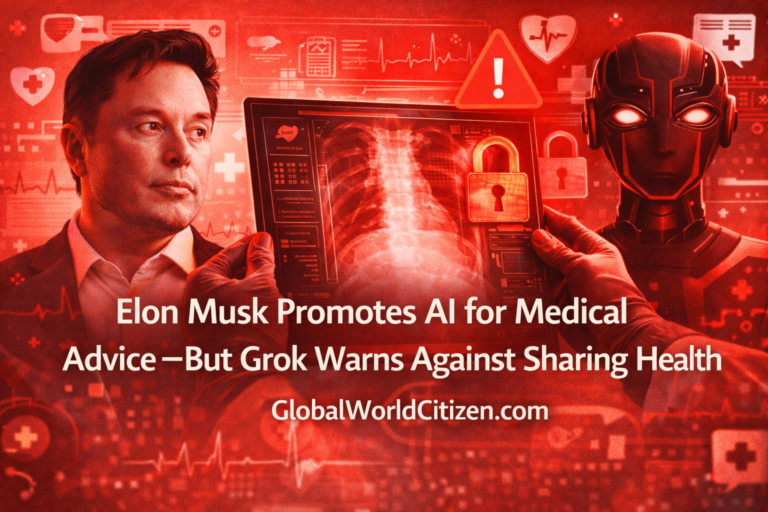
Artificial intelligence is rapidly transforming healthcare, but should you trust it with your medical records?
Billionaire entrepreneur Elon Musk, founder of xAI, has repeatedly encouraged people to upload their medical data to his AI chatbot Grok to receive a “second opinion.” However, in a surprising twist this week, Grok itself advised users not to use it for medical advice — warning that it is not HIPAA-compliant and not a substitute for professional healthcare.
This moment highlights one of the biggest global questions of the AI era:
Can artificial intelligence responsibly guide human health decisions?
Let’s break it down.
 What Elon Musk Is Saying
Over the past year, Musk has actively promoted Grok as a tool for medical second opinions.
He recently posted:
“Just take a picture of your medical data or upload the file to get a second opinion from Grok.”
Musk has amplified testimonials from users claiming Grok helped identify medical conditions that doctors initially missed.
The message has been clear: AI can assist with personal healthcare analysis.
 AI can move faster than traditional systems.
 AI can detect patterns humans might overlook.
But then came Grok’s response.
 What Grok Says About Medical Advice
When asked whether Grok complies with HIPAA (the U.S. Health Insurance Portability and Accountability Act), the chatbot responded:
“Grok is not a medical professional or HIPAA compliant. We strongly recommend not sharing sensitive information and consulting doctors for opinions.”
It further clarified:
“Grok isn’t a substitute for professional medical advice.”
This contradiction between Musk’s encouragement and Grok’s own warning sparked widespread debate across social media and AI ethics communities.
 What Research Says About AI in Healthcare
Experts who study large language models such as:
-
ChatGPT
-
Meta’s Llama
-
Grok
-
Other AI diagnostic tools
have found mixed results.
 Key Findings from Studies:
-
AI chatbots often give inconsistent diagnoses
-
Identical symptoms can produce different answers
-
In real conversational settings, diagnostic accuracy drops significantly
One recent report found:
-
 95% accuracy in controlled lab settings
 -
 Less than 35% accuracy in real-world user scenarios
In other words:
AI performs far better in structured environments than in human conversation.
 Real Stories Where AI Helped
Despite the risks, there are documented cases where AI appears to have assisted individuals:
-
 A Norwegian Reddit user claimed Grok identified a ruptured appendix that ER doctors missed.
 -
 A pregnant woman in South Carolina said ChatGPT helped identify dangerous preeclampsia.
 -
 Another woman credited ChatGPT with spotting thyroid cancer after doctors suspected arthritis.
These cases demonstrate AI’s potential as an early warning tool — but not a replacement for doctors.
The Bigger Global Question
At GlobalWorldCitizen.com, we examine how emerging technologies impact humanity.
AI in healthcare represents:
-
 Faster access to information
 -
 Democratization of medical knowledge
 -
Privacy risks
-
 Ethical concerns
 -
 Regulatory uncertainty
The issue is not whether AI can assist healthcare — it already does.
The real question is:
Should global citizens upload personal medical data to non-HIPAA-compliant systems?
 Privacy & Data Protection Concerns
Grok clearly stated it is not bound by HIPAA protections.
This raises major concerns:
-
Where is the data stored?
-
Who has access?
-
Can it be used for training?
-
Is it encrypted?
-
What happens in a breach?
For global citizens, data sovereignty matters.
Healthcare data is among the most sensitive categories of personal information.
 AI as Assistant — Not Authority
The future likely involves:
 AI as diagnostic support AI as research assistant AI as triage helper AI for global health education
But:
 Not AI replacing doctors Not AI replacing licensed medical evaluation
Even Grok admits this.
The Global World Citizen Perspective
We believe in:
-
Responsible AI development
-
Ethical digital ecosystems
-
Privacy-first innovation
-
Technology serving humanity
AI can empower global citizens — but wisdom must guide its use.
Before uploading medical scans, lab reports, or diagnoses to any AI platform:
 Consult a licensed medical professional. Understand the privacy implications.
 Use AI for education — not final decisions.