
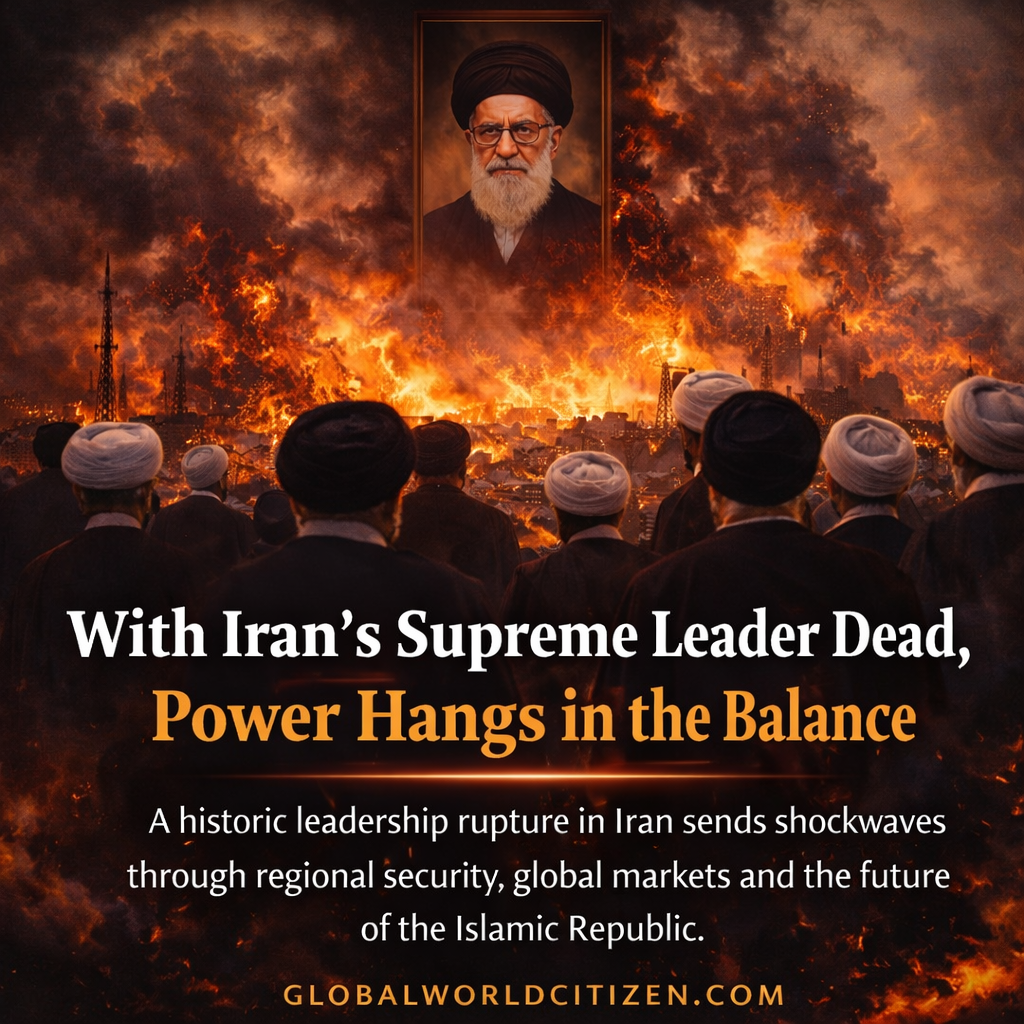
The death of Iran’s Supreme Leader marks one of the most consequential turning points in Middle East geopolitics in decades.
Following coordinated U.S.–Israeli airstrikes, Ali Khamenei — the central figure of Iran’s Islamic Republic for more than three decades — is confirmed dead. The strike not only eliminates a symbolic leader of the Iranian regime but also throws the country’s political system into profound uncertainty.
The question now is no longer whether escalation will continue.
It is who controls Iran next.
 The Constitutional Succession Crisis
Under Iran’s constitution, a temporary leadership council — composed of the president, chief justice, and a senior cleric — is tasked with managing the interregnum until a new Supreme Leader is appointed.
However, it remains unclear which senior officials survived the strikes.
Speculation had previously centered on Mojtaba Khamenei, the late leader’s son, as a possible successor. Reports now suggest he may also have been killed.
If confirmed, that would eliminate the most obvious dynastic transition scenario.
Iran may attempt to designate:
A senior clerical successor
A collective leadership committee
Or allow the Islamic Revolutionary Guard Corps (IRGC) to consolidate power directly
Each option carries significant implications for regional stability.
 The Role of the IRGC
For years, real power inside Iran has been widely viewed as residing not only in the clerical establishment but in the Islamic Revolutionary Guard Corps (IRGC).
Many senior IRGC figures were reportedly killed in the strikes, including high-level commanders and strategic advisers.
Yet the IRGC is not a single personality.
It is a vast security apparatus with deep institutional roots.
Even with leadership losses, its structural capacity remains formidable.
This is not a monarchy dependent on a single heir.
It is a hardened security state built over four decades.
 Risk of Fragmentation and Regional Instability
Iran is home to more than 90 million people and contains diverse ethnic communities, including:
Kurds
Arabs
Azeris
Baluchis
In a leadership vacuum, centrifugal pressures could intensify.
Regional powers are watching closely.
Memories of post-regime collapse chaos in Iraq (2003) and Libya (2011) remain fresh across the Middle East.
A fractured Iran could destabilize:
Iraq
Syria
Lebanon
The Persian Gulf energy corridor
And most critically — the Strait of Hormuz.
 Energy & Strategic Shockwaves
Even as internal succession unfolds, Iran’s military has reportedly launched retaliatory missile strikes across the region and announced restrictions affecting the Strait of Hormuz — through which roughly one-third of global seaborne oil passes.
Tanker diversions have already begun.
Energy markets are responding to uncertainty, not just destruction.
A prolonged leadership crisis could embed a lasting geopolitical risk premium into global oil prices.
 America’s Strategic Gamble
President Donald Trump has framed the strike as a decisive blow against what he calls a destabilizing regime.
But removing a leader does not automatically create political order.
Three potential scenarios now emerge:
 Managed Transition
A pragmatic successor emerges and signals willingness to negotiate sanctions relief.
 Hardline Consolidation
The IRGC tightens control and adopts a more aggressive regional posture.
 Fragmentation
Factional struggles weaken central authority, increasing instability and regional spillover risk.
History suggests regime decapitation often produces unintended consequences.
 Global Affairs Perspective
This moment is larger than a headline.
It is a stress test for:
The durability of Iran’s political system
The resilience of Middle East security architecture
Global energy stability
U.S. foreign policy doctrine
The future of sanctions and diplomacy
If regime change fails to produce rapid stabilization, Washington risks entanglement in an open-ended conflict — precisely the kind of prolonged Middle East campaign modern U.S. presidents have sought to avoid.
The coming weeks will determine whether this is a turning point toward regional recalibration — or the beginning of a deeper geopolitical storm.
At GlobalWorldCitizen.com, we continue monitoring:
Leadership succession signals
IRGC command structure changes
Oil market volatility
Strait of Hormuz traffic data
Regional proxy mobilization
Because power transitions in strategic states reshape global systems.
And Iran is one of the most strategic states in the world.