
 Performing for Free—And Winning Bigger Than Ever
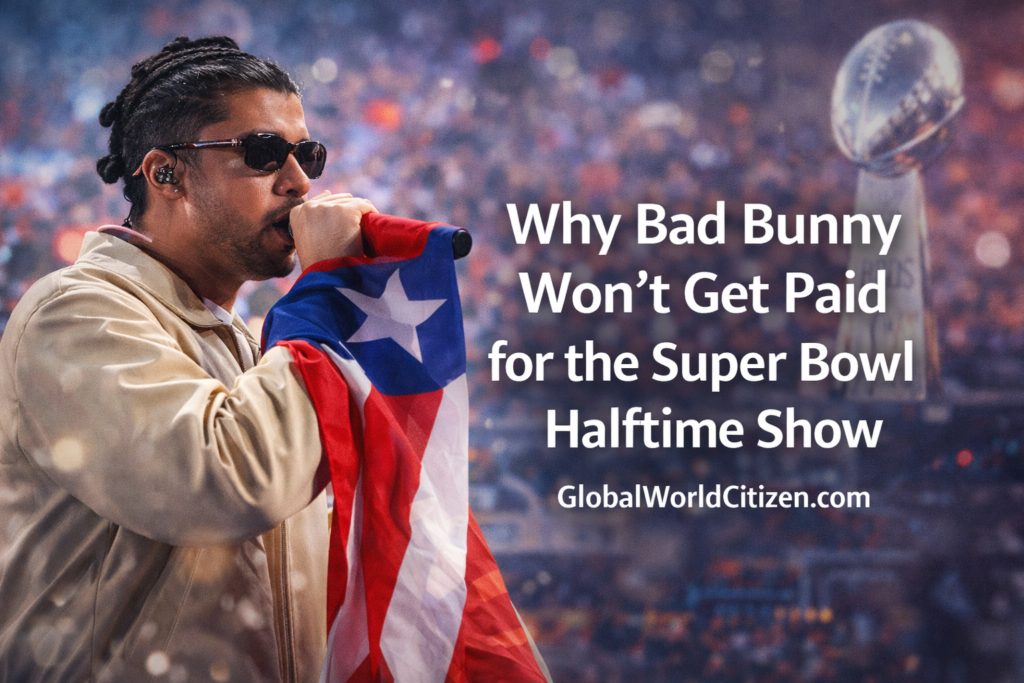
When Bad Bunny steps onto the Super Bowl LX halftime stage in San Francisco on February 8, he won’t be collecting a multimillion-dollar performance fee.
Instead, he’ll be doing something far more powerful.
The 31-year-old Puerto Rican superstar, born Benito Antonio Martínez Ocasio, is set to become the first Spanish-language headliner in Super Bowl history—marking a cultural turning point not just for the NFL, but for global entertainment itself.
And yes—he’s performing for free.
 Why Super Bowl Headliners Aren’t Paid
Despite the Super Bowl being the most watched entertainment event on Earth, halftime performers traditionally receive no salary, aside from minimal union-scale compensation.
Why?
Because the halftime show is widely regarded as the most valuable marketing platform in the world:
 130M+ live viewers
 Hundreds of millions more globally
 Immediate spikes in streams, sales, and tour demand
Last year’s halftime performer, Kendrick Lamar, saw:
 +430% increase in streams
 $360M stadium tour with SZA
 $109M earned in one year
The Super Bowl doesn’t pay cash—it prints cultural capital.
 Latin Music Has Arrived—Officially
Bad Bunny’s selection is not accidental.
According to Spotify data:
 Latin music consumption has surged 2,500% in the last decade
 It now accounts for 27% of all global streams
 Bad Bunny was Spotify’s most-streamed artist, with 19.8 billion streams in 2025
This halftime show signals one thing clearly:
Latin music is no longer a niche—it’s a global force.
 Culture, Identity & Defiance on the World’s Biggest Stage
Bad Bunny’s artistry has always been inseparable from Puerto Rican identity, language, and resistance.
Despite pressure to “cross over” into English-language pop, he has never compromised.
“Spanish is part of me. It’s in my DNA.” — Bad Bunny
That authenticity has transformed him into a symbol of pride for millions—especially Latino and Hispanic communities worldwide.
 For many fans, this Super Bowl performance isn’t just entertainment.
It’s representation.
 The ICE Factor & Political Undertones
The performance also lands amid heightened immigration tensions in the U.S.
Bad Bunny previously announced he would avoid U.S. touring due to concerns over ICE presence and the safety of his predominantly Hispanic fanbase—making his Super Bowl appearance a striking contradiction, and a calculated statement.
While former President Donald Trump has openly criticized the selection and said he won’t attend, ICE has confirmed it will be on patrol during the event.
Many experts believe Bad Bunny will subtly—or boldly—use the stage to address:
Immigration
Identity
Power
Cultural respect
 In this context, the halftime show becomes political theater—whether spoken or not.
 A Career at Its Peak
The Super Bowl caps off a massive year for Bad Bunny:
 31 sold-out shows in Puerto Rico Roles in major Hollywood films
 $66M earned in 2025 (Forbes estimate) One of the most influential artists alive
And yet—he’s choosing impact over payment.
 The Bigger Picture
The Super Bowl halftime show has evolved from a concert into a global amplifier.
For Bad Bunny, this moment represents:
The global rise of Spanish-language culture
A challenge to traditional American entertainment dominance
A declaration that you don’t need to assimilate to lead
This isn’t just a performance.
It’s a shift in global culture.
 Final Take
Bad Bunny may not get paid in dollars for the Super Bowl halftime show—but the return on influence, reach, and legacy could be immeasurable.
This is how modern power works: Music → Culture → Influence → Wealth
And Bad Bunny understands the game better than anyone.