
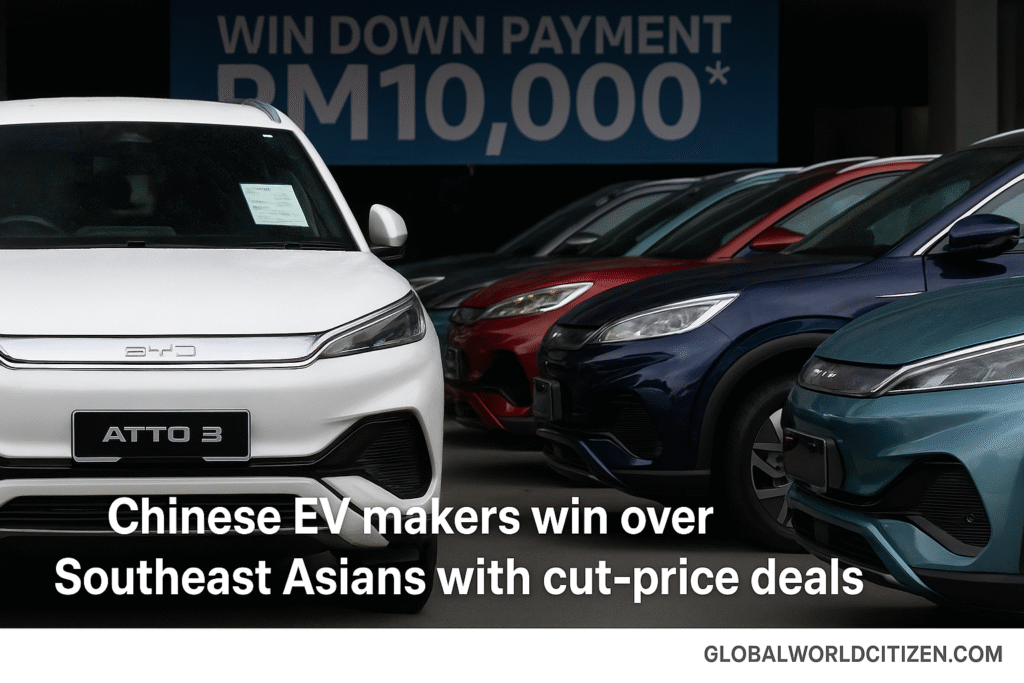
KUALA LUMPUR / BANGKOK / SINGAPORE – A wave of Chinese electric vehicle (EV) makers is transforming the Southeast Asian automotive market, winning over consumers with cut-price deals, advanced features, and aggressive expansion strategies. From Malaysia to Thailand and Vietnam, brands like BYD, Chery, Great Wall Motor, and SAIC are challenging the long-dominant Japanese automakers and reshaping the future of mobility in ASEAN.
 BYD and the Rise of Chinese EVs in Southeast Asia
Malaysian businessman Vincent Hor recently bought a BYD Atto 3 SUV at a steep 27% discount, citing its voice commands, rotating touchscreen, and low maintenance costs as key selling points.
“It’s just like a smartphone. It needs to be replaced after a while to keep up with technology,” Hor said.
He represents the new wave of early adopters across Southeast Asia lured by discounted EV prices and government incentives.
 Explosive Growth of EV Sales
EV sales in Southeast Asia surged 79% year-on-year in H1 2025, according to Counterpoint Research.
Chinese EV brands now account for 57% of the region’s EV sales, recording 67% YoY growth.
Nearly 18 Chinese automakers operate in ASEAN, with BYD, GAC, Chery, SAIC, Wuling, Changan, and Great Wall Motor leading the charge.
Thailand EV penetration: 18% of total car sales in early 2025, up from 6% the previous year.
Singapore milestone: BYD surpassed Toyota as the top-selling car brand in H1 2025.
 The EV Price War
Chinese automakers are replicating their home-market strategy in Southeast Asia by offering 8%–20% discounts off catalog prices.
In Malaysia, Hor bought his BYD SUV through a used-car platform at “demo” pricing.
In Thailand, leftover cars from Bangkok’s motor shows are sold at 15% less.
BYD distributors have even faced consumer watchdog investigations over aggressive discounting.
This strategy, however, has raised concerns about sustainability:
Falling resale values risk eroding consumer confidence.
Dealers complain about undercutting, forcing them into near-zero margins.
Experts question whether all 129 Chinese EV brands can survive — consultancy AlixPartners predicts only 15 will remain by 2030.
 Thailand and
  Indonesia: The New EV Manufacturing Hubs
Chinese automakers are also building production capacity in Southeast Asia:
BYD: $1.3 billion plant in Indonesia + Rayong factory in Thailand (exports to Europe start late August 2025).
Changan & GAC Motor: Began production in Thailand.
SAIC-GM-Wuling: Factories in Indonesia and Malaysia.
Thailand’s Chonburi province has become a key storage hub for Chinese EVs, with thousands of cars parked near Laem Chabang Port, highlighting the scale of imports.
 Vietnam: VinFast Defends Its Home Turf
Vietnam’s VinFast remains the only Southeast Asian brand capable of competing with Chinese automakers.
Sold 87,000 units in 2024, 2.5x more than the previous year.
Sales tripled again in H1 2025, reaching 67,569 units.
Outperformed Chinese brands in its domestic market, cementing its role as a regional EV champion.
 Japanese Automakers Under Pressure
Chinese EV makers are eating into the market share once dominated by Japanese brands:
Japanese OEMs in ASEAN-6 fell to 63.9% in 2024 from 68.2% in 2023.
Once commanding 90%+ of Thai and Indonesian markets, their dominance is rapidly declining.
Companies like Honda, Suzuki, and Nissan are downsizing operations and consolidating production in Thailand.
Japanese automakers are responding by:
Focusing on hybrids to appeal to cautious buyers.
Leveraging after-sales service, financing, and dealer networks — areas Chinese players struggle to replicate.
 GlobalWorldCitizen.com Insight
The battle for Southeast Asia’s EV market reveals broader global trends:
Chinese EV makers: Leveraging aggressive pricing, strong supply chains, and government incentives to dominate emerging markets.
Japanese automakers: Struggling to adapt quickly but banking on hybrid technology and service reliability.
Southeast Asian consumers: Benefiting from unprecedented discounts and access to cutting-edge EV technology.
Global impact: Chinese brands are set to account for 30% of worldwide auto sales by 2030, with the largest growth in emerging markets.
Yet sustainability remains the big question: Will Chinese EV brands consolidate, or will the price war damage long-term consumer trust?