
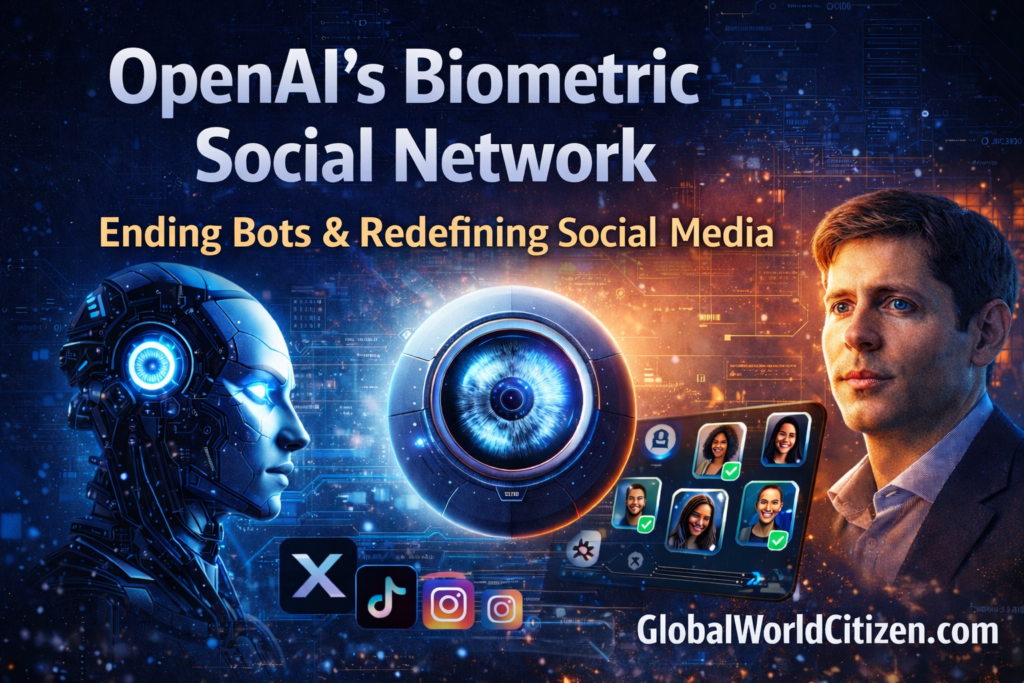
 The Internet’s Biggest Problem: Bots Everywhere
The modern internet is drowning in bots.
From crypto pump schemes and spam replies to AI-generated outrage, fake engagement, and synthetic influence campaigns, social platforms—especially X (formerly Twitter)—have become hostile terrain for real human conversation.
Now, OpenAI appears ready to launch a radical solution.
According to multiple reports, OpenAI is quietly developing its own social network, one designed from the ground up to solve the internet’s most corrosive problem:
How do you know if you’re talking to a real human anymore?

 The Core Idea: Proof of Personhood
At the heart of OpenAI’s proposed platform is a concept gaining serious traction across tech, crypto, and AI governance:
Proof of Personhood
Sources familiar with the project say OpenAI has explored biometric verification as a core onboarding requirement—ensuring that every account represents a real, living human being.
 Potential verification methods include:
 Apple Face ID
- World’s iris-scanning Orb
(Developed by Tools for Humanity, chaired by OpenAI CEO Sam Altman)
Unlike email or phone verification—which bots can easily bypass—biometrics cannot be faked at scale.
This would make OpenAI’s social network:
 Bot-resistant
- Spam-free
- AI-aware but human-verified
A real-humans-only digital public square.
 Why This Matters: X’s Bot Crisis Became the Tipping Point
For years, Twitter/X has been ground zero for bot activity.
Despite Elon Musk’s repeated promises to “defeat the bots,” the problem accelerated after:
 Massive layoffs (≈80% of staff)
 Trust & Safety teams gutted
 Explosion of LLM-powered accounts
Even after purging 1.7 million bot accounts in 2025, spam and synthetic engagement remain rampant.
Sam Altman himself has publicly criticized this shift, warning that:
What Would an OpenAI Social Network Look Like?
While still in early development (fewer than 10 people reportedly working on it), insiders suggest several defining features:
 Platform Vision
Real humans only (biometric verification)
AI-assisted content creation
Built-in tools for AI video, images, and text
Deep integration with ChatGPT and Sora
Think:
A social network designed for the AI age—but grounded in human identity.
 AI Content Is Coming—But With Guardrails
Synthetic content is inevitable.
Instagram, TikTok, and Threads already allow:
AI-generated images
AI-assisted video
Algorithmic amplification
The difference?
 OpenAI’s platform could ensure that even AI-generated content is tied to a verified human being.
No bot armies.
No anonymous manipulation.
No fake virality.
 Privacy vs Trust: The Global Debate
Biometric verification is powerful—but controversial.
 Risks:
Iris scans are permanent
Data breaches could be catastrophic
Surveillance concerns remain real
Counter-argument:
Without identity, trust collapses
Without trust, democracy, markets, and discourse fail
AI at scale requires new trust primitives
This is not just a tech issue—it’s a civilizational one.
 OpenAI’s Strategic Gamble
OpenAI has a proven track record of consumer virality:
 ChatGPT: 100M users in 2 months; now 800M+
- Sora: 1M downloads in under 5 days
But social media is a brutal battlefield.
OpenAI would face:
Meta’s Instagram & Threads
TikTok’s AI-native ecosystem
X’s entrenched political influence
Decentralized challengers like Bluesky
Yet OpenAI has something no other platform does:
 The Bigger Picture: Rebuilding the Internet for Humans
If OpenAI succeeds, this won’t just be another social app.
It would represent:
A new digital identity standard
A post-bot social architecture
A response to the “Dead Internet” era
A blueprint for AI-human coexistence
As feeds fill with “synthetic everything,” the platform that restores human certainty may win the future.
 Final Thought
This isn’t about killing bots.
It’s about saving the internet.