
Published: 2 March 2026 Source: Arabian Business Editorial Desk: Global World Gulf Intelligence
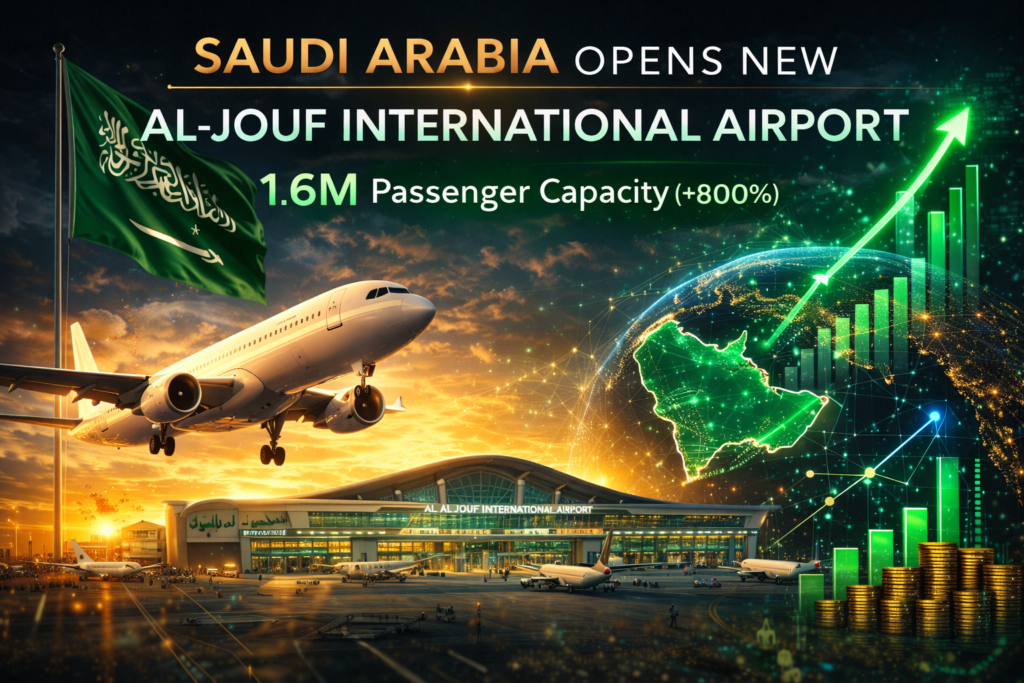
Saudi Arabia has officially launched the new Al-Jouf International Airport, marking one of the most significant regional aviation capacity expansions in the Kingdom’s infrastructure drive under Vision 2030.
The new facility began operations on February 25, replacing the previous airport and increasing annual passenger capacity from approximately 175,000 to 1.6 million — an expansion of more than 800 percent.
The airport operates under the Second Airports Cluster and forms part of Saudi Arabia’s broader aviation modernization and regional economic development strategy.
Strategic Infrastructure Scaling
The expansion represents a deliberate capital investment into regional connectivity designed to:
• Strengthen domestic air transport corridors
• Support tourism and logistics growth
• Enable commercial expansion in Al-Jouf
• Advance Vision 2030 aviation and diversification targets
The new passenger terminal spans 24,000 square metres, built to modern international aviation standards and structured for long-term traffic growth.
Key Infrastructure Features:
16 check-in counters (including two self-service)
11 departure and arrival gates
Five dual passport control counters
648 parking spaces
1,700 square metres of commercial space
This scale-up materially enhances regional passenger throughput capacity and operational efficiency.
Economic and Capital Implications
Infrastructure of this magnitude typically produces multi-layered economic effects:
• Increased tourism inflows
• Retail and hospitality sector expansion
• Logistics and cargo potential
• Real estate development spillover
• Private sector participation opportunities
While Al-Jouf is not among Saudi Arabia’s primary international hubs, the 800% capacity increase signals deliberate long-term regional growth positioning rather than incremental expansion.
Vision 2030 Alignment
Saudi Arabia’s Vision 2030 blueprint prioritizes transport infrastructure expansion to support diversification away from oil dependency. Regional airports such as Al-Jouf function as enabling platforms for:
• Industrial growth
• Cross-regional mobility
• Foreign investment support
• Domestic economic integration
The development reinforces Saudi Arabia’s broader aviation modernization campaign as the Kingdom increases national passenger and logistics capacity.
Inclusive & Heritage-Integrated Design
The terminal integrates accessibility features including:
• Sensory rooms for travellers with Autism Spectrum Disorder (ASD)
• Dedicated services for passengers with disabilities
• Passenger-centric layout and flow
Architecturally, the facility incorporates design elements inspired by Al-Jouf’s heritage, including approximately 5,000 square metres of landscaped green space featuring olive trees, a regional hallmark.
Capital Signal Assessment
Sector: Infrastructure & Aviation
Capital Intensity: High (Public Infrastructure Scale)
Time Horizon: 2026–2035
Diversification Relevance: Strong