
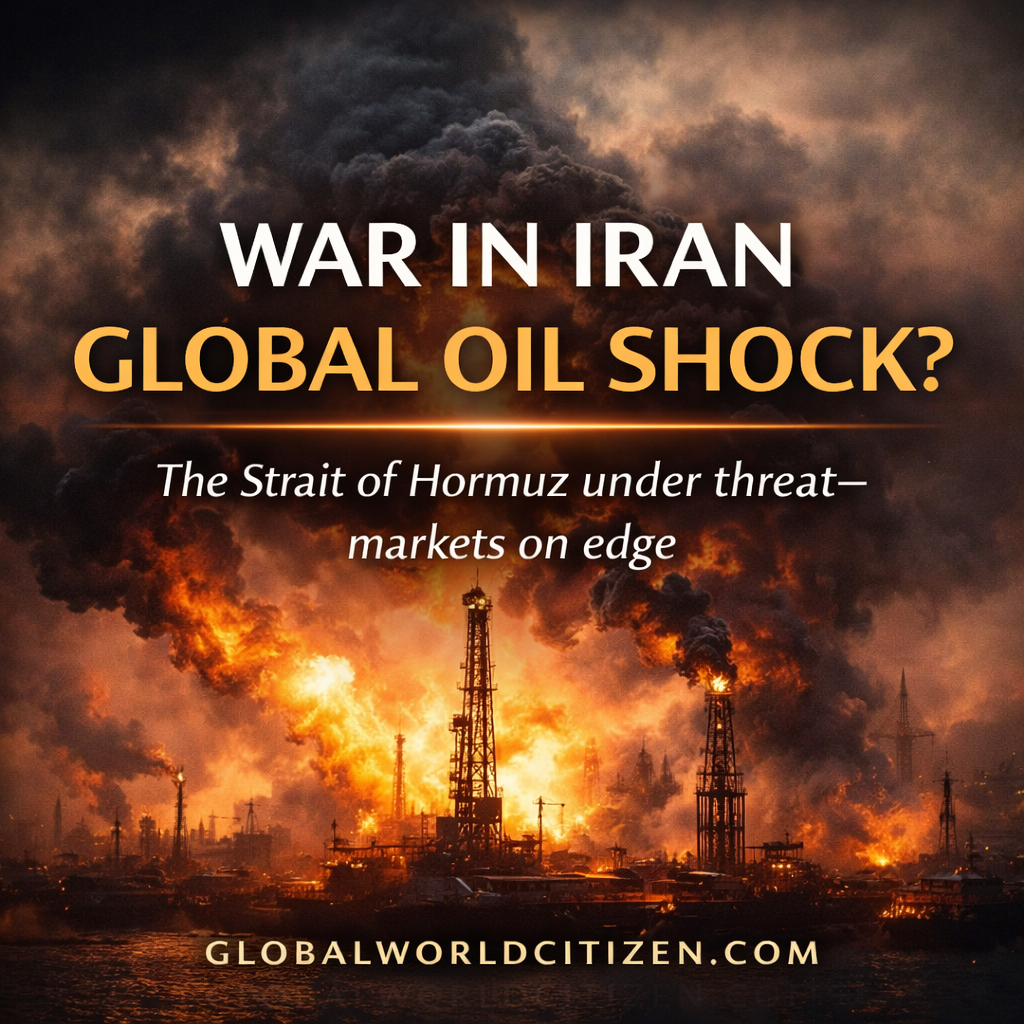
The escalating war in Iran is no longer just a regional military confrontation — it is rapidly evolving into a potential global oil shock with far-reaching consequences for energy markets, inflation, and geopolitical stability.
Following coordinated U.S.–Israeli strikes that reportedly killed Iran’s Supreme Leader and targeted critical state infrastructure, markets are now bracing for supply disruptions across one of the world’s most strategically vital energy corridors.
Oil traders were already on edge before the weekend escalation.
Brent crude closed at $73 per barrel, its highest level since July, already trading nearly $10 above supply-demand fundamentals. Earlier this year, analysts had predicted a global oil surplus driven by rising Gulf production and moderate demand growth. The International Energy Agency forecast a 3.7 million barrel-per-day surplus for 2026.
Instead, rising tensions in the Middle East have flipped the narrative.
 The Strait of Hormuz: A Global Energy Flashpoint
At the center of the risk lies the Strait of Hormuz, a narrow waterway through which approximately 15 million barrels per day — nearly one-third of global seaborne oil trade — flows.
A blockade or sustained disruption could push oil prices toward $100 per barrel.
Even without a full closure, the risk premium embedded in energy markets is growing.
Missile exchanges, naval maneuvers, satellite interference, and heightened maritime security threats are already affecting tanker movements. Insurance rates are rising sharply, and multiple vessels have reportedly altered course rather than transit the Strait.
Alternative pipeline routes through Saudi Arabia and the UAE exist — but at full capacity, 8–10 million barrels per day would remain exposed to Strait disruption.
The logistics risk is real.
 Why This Conflict Is Different
During previous flare-ups between Israel and Iran, oil markets reacted briefly but stabilized quickly. Iran’s energy infrastructure was largely spared, and retaliation remained symbolic.
This time is different.
U.S. President Donald Trump has indicated that military operations could continue for days or weeks. Iran’s response has been broader, targeting regional military assets and infrastructure.
Traders are not just pricing in temporary volatility.
They are pricing in sustained geopolitical uncertainty.
 Three Major Unknowns for Global Markets
 Will Iran Target Gulf Oil Infrastructure?
Oilfields in Saudi Arabia, the UAE, and Kuwait lie within missile range. A direct attack would dramatically escalate the conflict and likely invite retaliatory strikes.
Such a move would destabilize global energy security overnight.
 Can Oil Continue to Reach Markets?
Even if production holds, shipping disruptions alone can drive price spikes.
Satellite jamming, rising freight rates, maritime security risks, and insurance withdrawals are making transit through Hormuz increasingly hazardous.
Market stability depends not just on output — but on transport.
 Will Regime Change Occur?
If Iran’s leadership collapses and sanctions are lifted, Iranian oil exports could eventually increase, reinforcing global oversupply.
But if hardliners consolidate power, instability could persist for years. In that scenario, oil markets may permanently embed an $8–12 per barrel geopolitical risk premium.
Uncertainty itself becomes the structural driver.
 Inflation, Gasoline Prices & Political Risk
Oil shocks do not remain confined to commodity exchanges.
A $10 increase in Brent crude historically raises U.S. gasoline prices by roughly 25 cents per gallon, often within days.
Higher energy costs ripple through:
Transportation
Food supply chains
Consumer inflation
Central bank policy decisions
With U.S. midterm elections approaching, sustained oil price increases could intensify political pressures domestically.
The U.S. Strategic Petroleum Reserve currently holds approximately 415 million barrels, far below levels during previous global crises. At maximum draw rates, it would provide only short-term relief.
 Global Affairs Perspective
This is not merely an oil market fluctuation.
It is a systemic stress test for:
Global energy security
Maritime trade stability
Middle East geopolitical balance
Inflation outlooks
Central bank policy trajectories
For decades, global growth has relied on stable Gulf energy flows.
War in Iran challenges that assumption.
Energy markets now face a critical inflection point.
At GlobalWorldCitizen.com, we continue monitoring:
Brent crude volatility
Shipping data through Hormuz
OPEC production decisions
Insurance market reactions
Global inflation signals
Because this conflict is not just a headline.
It is a potential reordering of the global energy system.